

TECHNOLOGIES
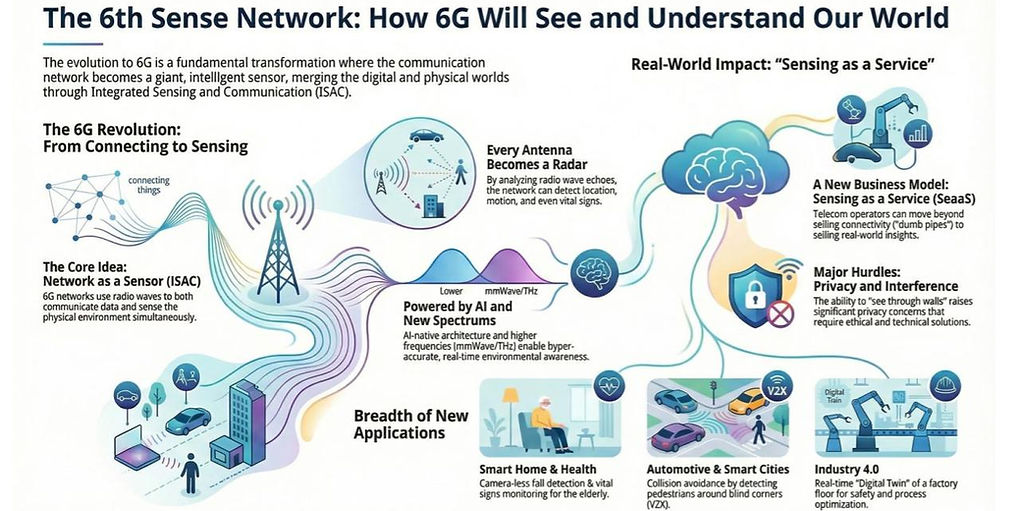

The IISAC consortium focuses on integrated sensing and communication (ISAC) as a key enabler for next-generation wireless systems. On this page we present the main ISAC use cases considered in our project, spanning B5G/6G networks, autonomous mobility, smart cities, industry, security, and more. These use cases guide our research, algorithm design, and system-level evaluations.
Main Use Cases
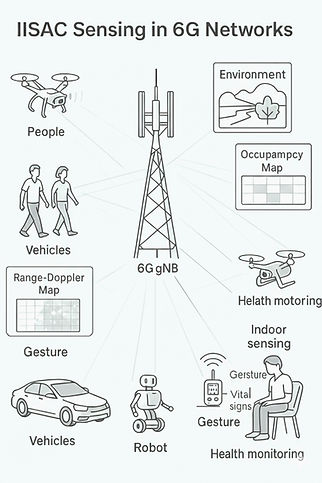
Key ISAC Use Cases
Next-generation B5G/6G Communication Networks
Integrated sensing and communication (ISAC) will be a core capability in future B5G/6G networks, enabling:
-
Reduced system complexity and signaling overhead in 5G/6G deployments
-
Lower cost, power consumption, and processing requirements
-
Higher network capacity and extended coverage, especially for dense IoT device deployments
Autonomous and Connected Vehicles (V2X)
-
Reliable communication between vehicles and roadside infrastructure
-
Lane detection and road-environment sensing
-
Smart traffic management and improved road safety
Smart Cities and Critical Infrastructure
-
Air-quality monitoring and environmental sensing
-
Crowd safety through object and people detection
-
Monitoring of public spaces, transportation hubs, and critical infrastructure
Healthcare and Well-being
-
Non-invasive medical monitoring using wireless sensing (e.g., breathing, heart rate, movement)
-
Elderly-care applications such as fall detection and activity monitoring
High-precision Localization and Industrial Automation
-
Accurate tracking of robots, AGVs, and industrial assets on the factory floor
-
Real-time inventory management and logistics tracking
-
Sub-meter localization for indoor and harsh environments
National Security and Defense
-
Joint radar and communication for surveillance and patrol
-
Detection and tracking of drones and other unwanted aerial/ground objects
-
Border protection combining communication links and sensing capabilities
-
Object detection and classification in complex environments
Next-generation B5G/6G Communication Networks
AR/VR and immersive applications
-
Precise user and device positioning for AR/VR headsets
-
Low-latency, high-reliability communication with built-in sensing for immersive experiences
Disaster management and public safety
-
Localization of survivors in disaster areas using wireless sensing
-
Real-time situational awareness for rescue teams
-
Infrastructure status monitoring after earthquakes, floods, or fires
Agriculture and Environmental Monitoring
-
Soil-moisture sensing and crop-condition monitoring
-
Livestock tracking and perimeter monitoring
-
Large-scale environmental sensing (water levels, pollution, etc.)
Aviation, Space and UAVs
-
Radar-based sensing and tracking of aircraft and unmanned aerial vehicles
-
Joint communication and sensing for air-traffic management
-
Spaceborne and high-altitude platform sensing and connectivity
Smart Buildings and Homes (optional section)
-
Presence, motion, and occupancy detection for energy-efficient HVAC and lighting
-
Security and intrusion detection using wireless sensing
AI Native, Digital-Twin–Driven Network
-
Integrated sensing and communication networks provide, among other things, powerful learning and inference capabilities based on generative AI (GenAI) and advanced machine learning:
We will provide the AI modules with a real-time view of the network state, based on data from sensors deployed in the operational network.
In parallel, we will develop and integrate the ISAC solutions with a Digital Twin (DT) of the network, as a high-fidelity Real time virtual replica that serves as an advanced training, testing, and optimization environment for AI-based IISAC modules.
The Digital Twin will be equipped with high-performance computing resources, enabling real-time training, adaptation, and configuration of neural networks and other AI models that control the IISAC network.
-
This AI-native approach allows prediction of the movement vector of mobile User Equipment (UE) and channel conditions everywhere in the area of interest, enable dramatic behavior, continuous optimization of coverage, capacity, sensing performance, and energy efficiency, while accelerating innovation and reducing development risk.